

The primary benefits of custom b2b customer portal systems center on operational efficiency, lower support costs, and order accuracy. Automating manual order entry eliminates expensive administrative bottlenecks. As a result, your team reclaims time while buyers get instant access to contract pricing and inventory.
What Are the Main Benefits of a Custom B2B Customer Portal?
The main benefits of a custom B2B customer portal include lower service costs, fewer order errors, and round-the-clock buyer access. Tailored engineering lets clients submit complex purchase orders and manage multi-user enterprise roles independently. Consequently, buyers get instant answers without calling your sales team.
Standard B2B transactions break down when buyers must wait for office hours to check invoice statuses. Providing 24/7 self-service access removes these friction points completely.
Enterprise buyers rarely operate with a single credit card or standard price sheet. Therefore, custom portal engineering builds contract-specific pricing tables and enterprise multi-user account hierarchies directly into your system. Because permissions match actual corporate approval flows, buyers submit purchase orders without back-and-forth emails.
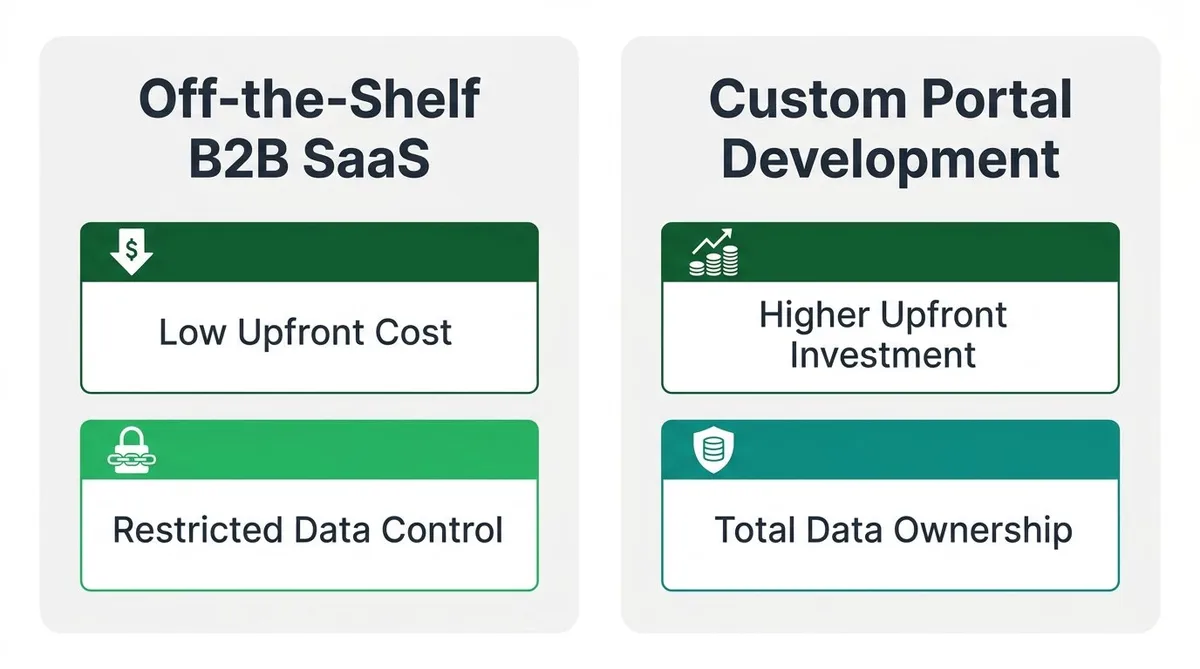
| Evaluation Metric | Off-the-Shelf B2B SaaS | Custom Portal Development |
|---|---|---|
| Upfront Cost | Low ($100 to $1,000 per month base fee) | Higher ($40,000 to $150,000 initial investment) |
| Development Timeline | 1 to 4 weeks for standard configuration | 3 to 6 months for complete engineering |
| Data Control | Restricted by third-party database schemas | Total ownership via Cloud Database Integration |
| Technical Scalability | Capped by system tiers and rigid API limits | Unlimited customization for unique business workflows |
SaaS platforms seem cheaper initially, but monthly seat fees and transaction cuts accumulate fast as you scale. In addition, rigid template limits often force your staff back into manual spreadsheet work.
Investing in custom customer portal development for distributors costs between $40,000 and $150,000 with a realistic 3-to-6-month delivery timeline. However, owning your platform eliminates recurring vendor fees and gives you total control over Workflow Automation and Internal Business Tools.
Partnering with a reliable b2b self service portal development agency like Neutron LLC ensures your build incorporates essential custom dealer portal software features. Consequently, your team saves dozens of administrative hours every week while scaling account volume effortlessly.
Architecting Real-Time ERP and Cloud Database Integrations
Linking Custom Web Apps directly to backend ERP engines changes how your wholesale business operates. When customers place orders, data flows immediately into your core system. As a result, your team stops re-keying invoices, which eliminates duplicate data entry errors and automates order tracking.
High-volume ordering can slow down older systems during peak sales hours. Implementing an asynchronous message queue prevents database locking during high-volume wholesale ordering. This architecture processes order requests in isolated queues, which keeps your primary database responsive while processing background updates.
Building reliable infrastructure is one of the core benefits of custom b2b customer portal platforms. For high performance, aim for API throughput benchmarks of 500 or more requests per second. Maintaining this speed keeps your Cloud Database Integration updated in real time. Consequently, your Internal Business Tools stay fast without risking system downtime.
Targeted custom customer portal development for distributors relies on specific technical standards to preserve stability:
- Asynchronous messaging: Queues incoming payloads to prevent database locking during traffic spikes.
- Decoupled microservices: Separates order intake from user management to protect server stability.
- High-throughput APIs: Sustains over 500 requests per second with response times under 200ms.
What Features Should a Custom B2B Customer Portal Include for Global Accounts?
A custom B2B customer portal for global accounts must include role-based permissions, order tracking, and centralized billing. It requires multi-currency pricing rules, automated customs documentation, and cross-border tax compliance tools. These custom dealer portal software features streamline international purchasing and eliminate tedious manual data entry for enterprise buyers.
Role-based access permissions allow account managers, procurement leads, and finance teams to view only their assigned data. Therefore, buyers approve orders independently without sharing sensitive credentials. Centralized billing consolidates invoices across departments, while live status tracking reduces routine phone calls.
However, global trade introduces tax rules and shipping regulations that can stall fulfillment. Specialized custom customer portal development for distributors solves this issue by automating key international trade tasks:
- Dynamic Multi-Currency Pricing: Automatically adjusts pricing based on live exchange rates or locked contract terms.
- Automated Customs Documentation: Generates commercial invoices and certificates of origin instantly at checkout.
- Cross-Border Tax Engines: Calculates localized VAT, GST, and regional taxes accurate to each delivery location.
Manual tax entry mistakes can cause costly customs holds and administrative fines. As a result, automated compliance rules protect net margins when shipping across multiple jurisdictions. Working with a b2b self service portal development agency like Neutron LLC brings custom portal development, cloud database integration, and workflow automation into a single secure platform built for complex global accounts.
Driving Client Adoption: Moving Wholesale Buyers Away from Manual Orders
Building a platform is only half the battle. Your business captures the true benefits of custom b2b customer portal software only when wholesale buyers actively use it.
You must set explicit migration benchmarks before rolling out your platform. For example, target 80% portal adoption among active accounts within the first 90 days post-launch. Tracking this metric prevents your team from accepting manual orders indefinitely.
Transitioning buyers away from phone calls and email orders requires a structured plan. Use this step-by-step change-management framework to guide your client accounts:
- Audit legacy order habits: Identify client accounts sending high-volume PDFs or spreadsheets via email.
- Pre-configure buyer accounts: Provision portal logins automatically so buyers skip lengthy registration forms.
- Train sales representatives: Show account reps how workflow automation eliminates administrative headaches.
- Set a clear migration date: Communicate when manual order entry will end for routine inventory purchases.
Traditional buyers often resist new web tools because they prefer familiar routines. However, targeted incentives quickly eliminate this friction.
For instance, offer exclusive payment terms or prioritized order queueing for buyers using your portal. As a result, your clients gain faster fulfillment while your operations team eliminates manual data entry.
ROI Breakdown: Operational Savings from B2B Self-Service Portals
Evaluating the practical benefits of custom B2B customer portal investments requires looking at concrete labor savings. Consider a distributor handling 5,000 order transactions per month through manual entry. Because staff spend hours copying order details from emails into spreadsheets, processing costs average $15 per order.
That manual process costs $75,000 in monthly operating expenses. Partnering with a specialized b2b self service portal development agency like Neutron LLC changes this financial equation. By deploying Workflow Automation and AI Automation, orders flow straight into your fulfillment system without human intervention.
As a result, processing costs drop from $15 down to $2 per order. Reducing processing expenses by $13 per transaction yields a substantial operational payload over time:
- Monthly Order Volume: 5,000 transactions
- Manual Intake Cost ($15/order): $75,000 per month
- Automated Portal Cost ($2/order): $10,000 per month
- Monthly Net Savings: $65,000
- 24-Month Net Savings Payload: $1,560,000
Therefore, automated self-service yields over $1.5 million in operational overhead savings across 24 months. These net savings allow growing distributors to recoup their initial software engineering costs within six months.