

A technical seo audit checklist for service business websites isolates code and speed issues that block potential clients. Reviewing your core infrastructure ensures search engines discover your main service pages. As a result, you build better local reach and increase client bookings.
Technical SEO Audit Checklist for Service Business Core Infrastructure
Your backend setup controls how search engines inspect your site. Open Google Search Console to check indexation reports, because hidden robots.txt rules often block key booking pages. Next, verify that your XML sitemap is accurate and submitted correctly.
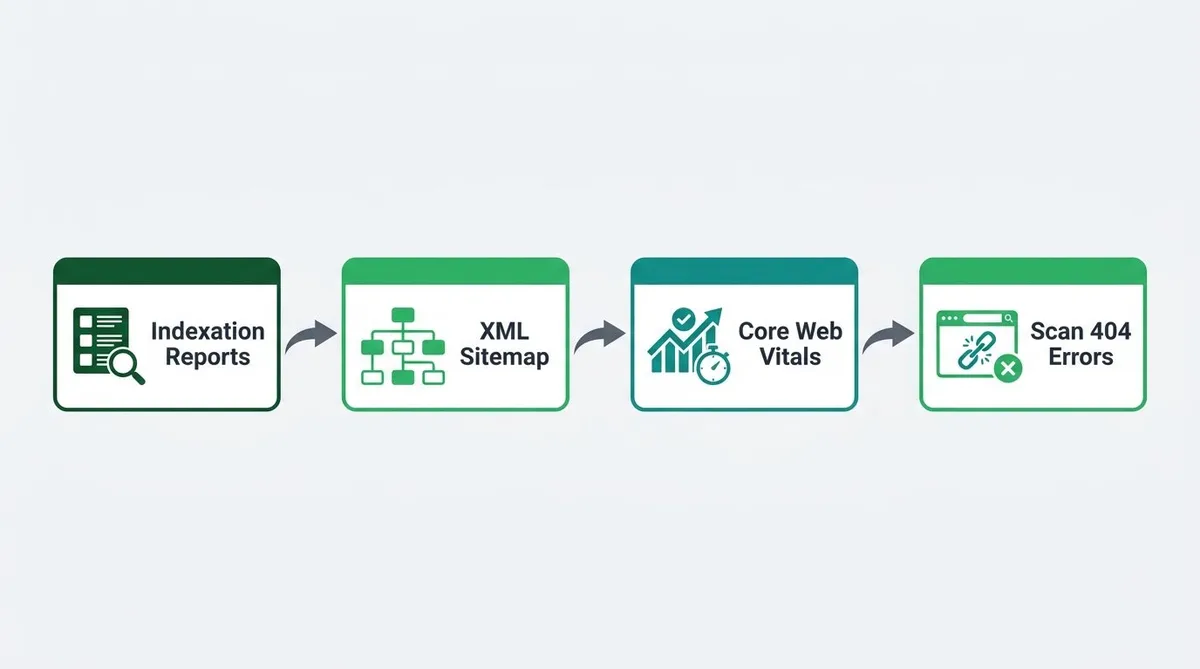
Clean sitemaps guide search bots directly to active service pages. Therefore, search engines index your latest updates much faster.
Slow loading times cause potential clients to leave before booking. Evaluate your Core Web Vitals to remove mobile performance bottlenecks like bloated images and heavy scripts. Understanding how to improve search visibility for service companies starts with fixing these speed delays.
Streamlined Web Design and optimized Cloud Database Integration maintain high page speeds. As a result, fast loading times convert mobile traffic into booked jobs.
Broken links frustrate users and waste your crawl budget. Run systematic scans using Screaming Frog and Google PageSpeed Insights to catch 404 errors and broken redirects. However, simple technical errors can slip through without regular scans.
Resolving these issues keeps search engines crawling your site efficiently. Investing in technical seo audit services for small business growth protects your digital tools. This step is critical before you hire technical seo consultant for website redesign projects.
What Is Included in a Technical SEO Audit for Local Service Companies?
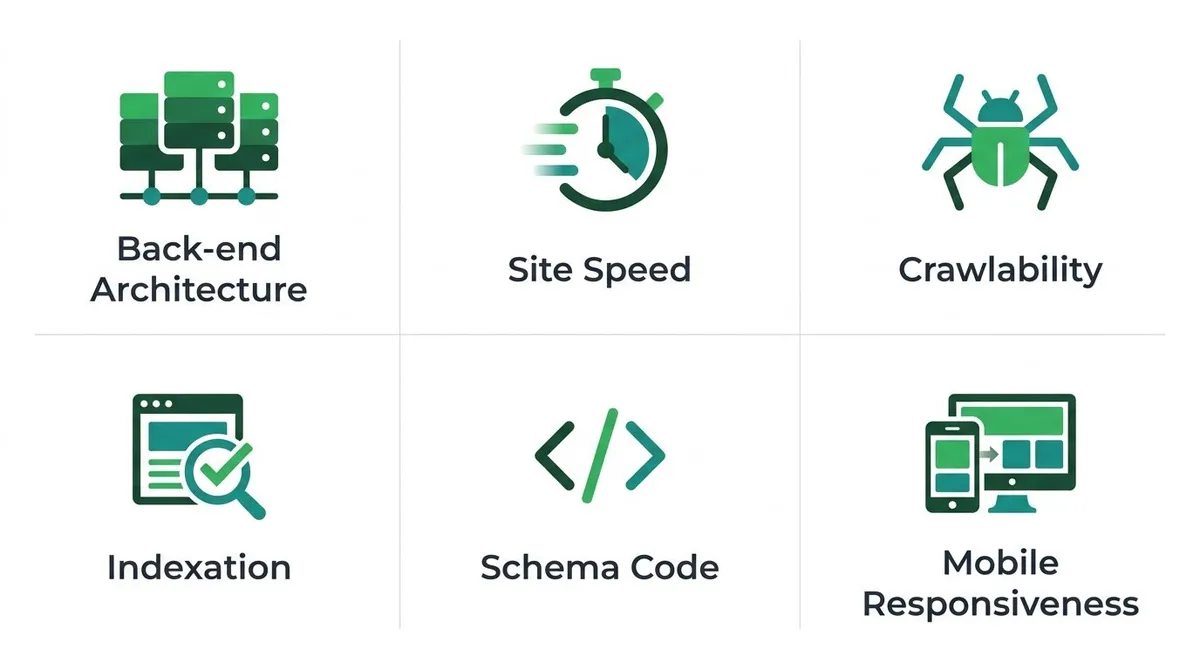
A technical SEO audit for local service companies examines back-end architecture, site speed, crawlability, indexation, schema code, and mobile responsiveness. Unlike surface reviews, this evaluation fixes deep infrastructure defects. It ensures search engines read your service areas, booking forms, and business information.
Many business owners confuse written copywriting with underlying web performance. However, rewriting page text will not boost rankings if search bots cannot index your booking forms. A complete evaluation separates backend structural defects from frontend content updates.
While content audits focus on keywords, a technical assessment inspects server response codes, XML sitemaps, and database calls. Therefore, fixing these infrastructure bottlenecks ensures your marketing text actually reaches local clients. If you plan to hire technical seo consultant for website redesign work, start with this underlying infrastructure.
Structured code helps search engines interpret your actual service footprint. By implementing valid LocalBusiness structured data, you explicitly define your physical address, phone numbers, opening hours, and operating radius. As a result, search engines connect your service offerings directly to geographic searches.
Name, Address, and Phone (NAP) details must remain strictly consistent across every page. Mismatched phone numbers in footers or outdated addresses on landing pages confuse search crawlers. Consequently, auditing every footer and contact page protects your site authority.
To understand how to improve search visibility for service companies, you must map site errors to practical fixes. Below is a decision framework to diagnose common technical issues and apply exact remediation steps.
| Site Symptom | Root Cause | Technical Remediation Step |
|---|---|---|
| Indexation Drops (Pages suddenly disappear from search results) |
Accidental noindex tags, blocked robots.txt files, or broken canonical links. | Audit site header tags, fix robots.txt rules, and resubmit XML sitemaps through Search Console. |
| Slow Page Execution (Pages take longer than 3 seconds to load) |
Uncompressed media, bloated code, or inefficient Cloud Database Integration. | Compress image assets, clean up heavy scripts, or upgrade to high-performance Custom Web Apps. |
| Schema Validation Errors (Rich snippets missing in local search) |
Missing required JSON-LD properties or syntax errors in schema markup. | Rebuild local schema tags using exact guidelines and validate through Google testing tools. |
| Inconsistent Local Signals (Local map rankings drop suddenly) |
Conflicting NAP data in page footers or missing regional landing tags. | Standardize footer text across all pages and align metadata with Google Business profile details. |
Using professional technical seo audit services for small business operations removes guesswork from web maintenance. For companies built on high-converting Web Design and reliable Search Engine Optimization (SEO), teams like Neutron LLC engineer systems that run without manual fixes.
How to Handle Multi-Location SABs Without Duplicate Content Penalties
Service area businesses (SABs) without physical storefronts often struggle to organize target city pages. You must build a clean URL hierarchy that search engines can crawl easily.
Avoid flat, parameter-based URLs like example.com/?city=dallas. Instead, create static subfolders like example.com/locations/dallas/. Therefore, your primary service hub passes authority directly to regional pages without confusing search crawlers.
Swapping city names on identical copy creates duplicate content issues across your site. As a result, search engines ignore thin location pages and suppress rankings. A strong technical seo audit checklist for service business sites must address thin landing pages directly.
To eliminate duplicate content penalties, build unique pages using distinct localized proof points:
- Localized customer reviews: Display feedback gathered from customers within that specific area.
- Regional project summaries: Detail past jobs completed in that specific municipality.
- Local regulatory details: Mention specific municipal permits or codes relevant to that service zone.
Integrating custom Workflow Automation can pull recent field jobs into city pages automatically. Consequently, your landing pages stay fresh without adding hours of manual data entry to your schedule.
Proper canonical tags and internal link trees protect your site when service zones overlap. Always set self-referential canonical tags on distinct city pages. However, if two nearby suburban pages share identical content, point their canonical tags to the main metro hub page instead.
Finally, link your location pages using structured parent-child menus. For example, link a regional hub page down to individual town pages. This internal linking strategy demonstrates how to improve search visibility for service companies expanding into new territories.
Fixing JavaScript Hydration Errors in Dynamic Booking Widgets
Heavy client-side JavaScript often delays element rendering on service websites. When dynamic scheduling widgets load late, search engine crawlers miss critical booking text and conversion links entirely.
Hydration errors happen when client-side script execution fails to match pre-rendered markup. As a result, Googlebot views your page as incomplete, which directly damages your search rankings.
Consider a service business running 50 location pages with an iframe-based scheduling plugin. Say the third-party widget fires heavy tracking scripts, pushing total blocking time to 4.2 seconds per page load.
Replacing that bloated third-party widget with a custom server-side rendered workflow built by Neutron LLC changes the execution sequence. Rendering HTML directly on the server cuts total blocking time down to 1.1 seconds. This performance boost eliminates script delays and restores full search indexation across all 50 landing pages.
You should always audit third-party script execution order when running a technical SEO audit for service business sites. Delay non-essential tracking code until core interactive elements render.
Understanding how to improve search visibility for service companies requires balancing page interactivity with raw execution speed. If your booking system needs a major structural overhaul, plan to hire technical seo consultant for website redesign architectural reviews before writing new application code.
Remediation Timelines and Developer Effort Across CMS Platforms
Fixing technical debt requires realistic scheduling based on your content management system. Legacy platforms often accumulate plugin bloat over years of unmonitored updates. However, closed site builders limit your control over server configurations and page rendering.
For example, optimizing database queries on custom setups takes dedicated engineering time. Meanwhile, template builders force you to work within strict platform boundaries. As a result, technical SEO audit services for small business must adapt to each environment's constraints.
| Common Technical Issue | CMS Platform | Estimated Developer Hours | Long-Term Effort Trade-Off |
|---|---|---|---|
| Slow render times & plugin conflicts | WordPress | 5–15 hours | Requires ongoing maintenance and security patches to prevent performance drops. |
| Restricted schema & canonical control | Squarespace / Wix | 2–6 hours | Quick to configure, but rigid templates prevent deep custom code optimizations. |
| Hydration errors & broken API endpoints | Custom Web Apps / React | 10–30 hours | Requires skilled engineering, but delivers maximum speed and full code control. |
Deciding between patching old code or migrating requires assessing long-term maintenance costs. You should hire technical seo consultant for website redesign projects if your legacy system consistently blocks core performance updates. Rebuilding your infrastructure is often the fastest way to improve search visibility for service companies when legacy platforms fail.
How Often Should a Service Business Perform a Technical SEO Audit?
A service business should perform a technical SEO audit annually for basic maintenance, quarterly for high-traffic sites, and immediately after major redesigns. Routine reviews expose broken booking forms and crawl blocks early. Consequently, you protect your local search visibility before silent technical errors drain potential customer leads.
Routine maintenance vs. event-driven triggers
Establish a predictable audit cycle to keep core service pages fast and fully indexed. However, major operational changes demand immediate technical evaluations:
- Quarterly reviews: Best for dynamic sites with frequent schedule updates or heavy booking traffic.
- Annual checkups: Ideal for smaller service sites with stable service offerings.
- Platform migrations: Critical whenever you transfer databases or change your content management system.
- Site redesigns: Mandatory before launch. You should hire a technical seo consultant for website redesign updates to prevent indexation loss.
Using technical seo audit services for small business maintenance proactively uncovers hidden errors before they damage lead generation. For example, an undetected script error can silently disable your booking workflow. Fixing server errors and site speed issues is key when assessing how to improve search visibility for service companies without losing active buyers.
Website reliability directly affects your operational targets. For guidance on balancing site investments with long-term strategic growth, utilize small business counseling resources from the U.S. Small Business Administration. Connecting technical site health with broader operational goals ensures your digital investments deliver measurable business results.